
Understanding Queen Anne's County Releases
A Queen Anne's County release record answers a precise question: when did one commitment at the detention center end, under whose authority, and where did the person go next? It is not the same as an arrest record. It is also not the same as a live custody roster. The record may exist as a movement log, commitment entry, jail management report, court order, sentence calculation, or VINE event. Since Queen Anne's County does not publish a named online release report, a request should describe the event and fields needed rather than assume the county uses a certain report title.
Release can mean a return to the community, but it can also mark a transfer. A person may leave after posting bond, release on recognizance, dismissal, sentence completion, probation, parole, or mandatory supervision. Another person may leave local custody for DPSCS, another county, federal authorities, or immigration custody. Escape, death, and temporary leave are different events and should not be described as ordinary community release. That range is why an online absence is only a clue.
Important: A name dropping from a custody source does not show whether the person entered the community or another agency's custody.
Queen Anne's County Release Types
The label on a Queen Anne's County detention record controls its meaning. Bond or recognizance ends the local commitment under court terms, but the criminal case remains open unless the docket says otherwise. Time served means the custodial part identified by the order has ended, though another commitment could still apply. Parole and mandatory supervision move a person into conditional community supervision. A transfer means custody continues elsewhere.
| Release type | What it means | Best next source |
|---|---|---|
| Bond or recognizance | Local custody ends under court-set terms | District or Circuit Court docket and detention record |
| Court order or dismissal | A judge or case action authorizes release | Court order plus actual departure entry |
| Time served or sentence end | The stated local custodial term ends | Sentence, credit record, and detention release time |
| Parole or mandatory supervision | Confinement changes to conditional supervision | VINE, DPSCS records, and local supervision office |
| Transfer or detainer pickup | Queen Anne's County custody ends but another custody begins | The named receiving agency or facility |
Read the court record and actual release entry together. A judge's order can precede the time of physical departure, and a projected date can change before it arrives. The public event should be described with the record's own terms, not a guessed label.
Queen Anne's County Release Fields
No county field dictionary confirms that every item below is kept in one public report. These are the operational fields worth naming in a narrow request. Ask the Queen Anne's County Department of Corrections to identify what is held and releasable. Enough identity detail helps separate people with the same name, while the commitment number ties the event to the correct jail stay.
| Field to request | What it can establish |
|---|---|
| Name and distinguishing identifier | Which person the entry concerns |
| Booking or commitment number | Which detention episode ended |
| Admission date and time | When the local commitment began |
| Actual release or transfer date and time | When physical custody at the center ended |
| Release authority or document | Who or what authorized the event |
| Release type or destination | Community departure versus transfer |
| Court, charges, or bond information | The associated public case context, when releasable |
Actual time is especially useful. The order time, entry time, and time a person walked out may differ. A court order proves legal authority, while the detention center's release entry is the best direct local source for physical departure. Internal medical, incident, classification, and security material may follow other disclosure rules.
Request Queen Anne's Release Records
For an actual detention-center departure, the likely custodian is Queen Anne's County or its Department of Corrections, not the Sheriff's Office. Begin with the county public-information gateway. The county form routes mailed requests through the County Commissioners Office and also supplies an email route. A short date range and a clear list of fields reduce confusion about the record sought.
- Identify the person, the Queen Anne's County Detention Center, and a narrow commitment or date range.
- Ask for the actual release or transfer date and time, event type, authority, booking number, court or agency, and destination indicator to the extent public.
- Request electronic records, field definitions, and the code key. Ask that any withheld part be tied to a legal basis while releasable portions are supplied.
- Use the detention center's published phone line if the correct custodian or record name is unclear, but do not assume an oral answer is a certified record.
- If the event involved state custody or a court order, send a separate focused request to DPSCS or the appropriate clerk.
The county form says production is generally expected in fewer than seven days, while state law permits up to 30 days. The first two staff hours are free. Later staff time uses a Finance-assigned hourly rate, ordinary paper copies cost $0.25 per page, and large-format work is charged at actual cost. Those are form terms, not a promise about one Queen Anne's County release request.
The official county submission screen shows the route used for a local record request. See the Queen Anne's County submission gateway before preparing the request.
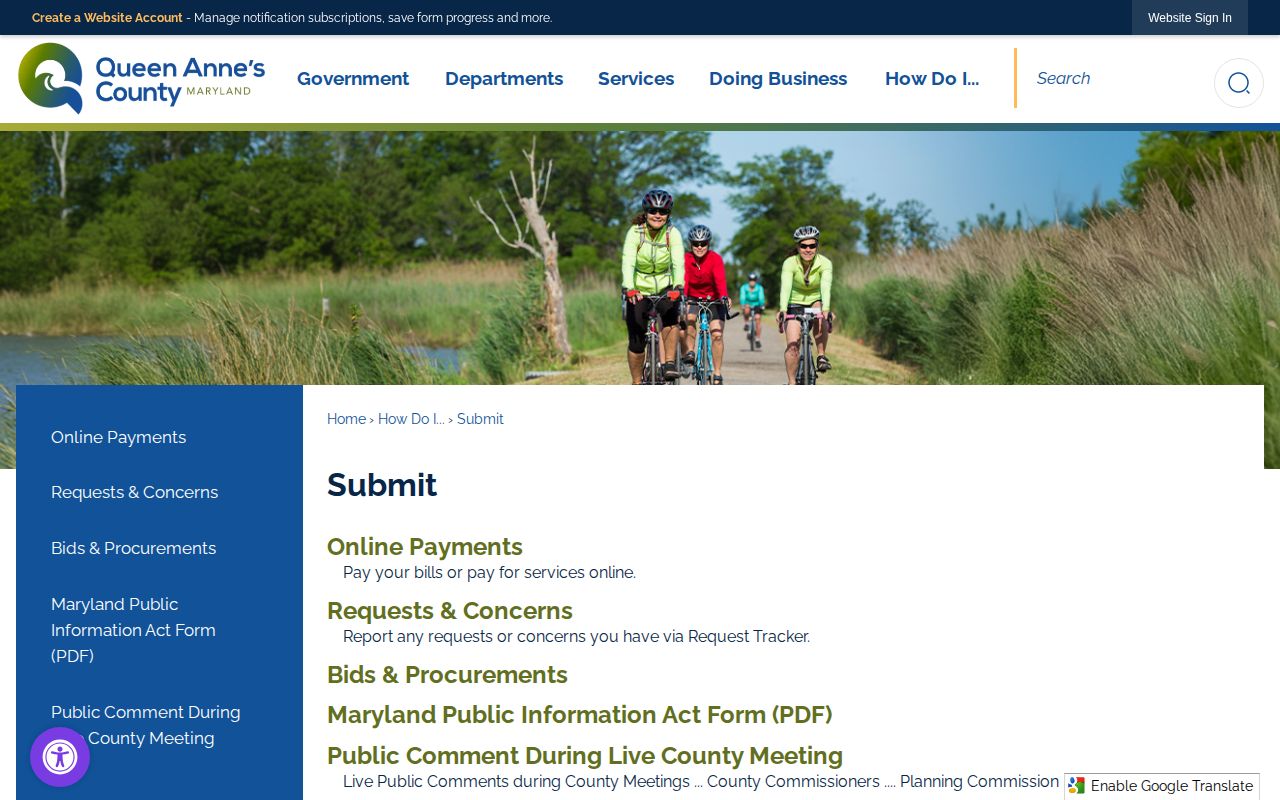
The screen connects a requester to county channels without implying that an instant public release list exists.
Maryland Rules for Queen Anne's Releases
The Maryland Public Information Act governs many agency-held records. General Provisions Section 4-201 addresses inspection, Section 4-203 sets response and explanation duties, and Section 4-206 permits reasonable fees. Required and permitted denials still apply. A custodian should separate releasable portions where possible rather than treat every field as all public or all withheld.
Court records use Maryland Rules 16-901 and following, so a PIA request to the county cannot replace the clerk's process. Juvenile, sealed, expunged, medical, protected personal, investigative, and security-sensitive information can be limited. No official online retention window was found for Queen Anne's County released inmates. Ask which record series holds the release event and whether older records moved to an archive.
Expungement is effective removal of eligible police and court records from public inspection. It is not a claim that a missing search result was erased. Eligibility and timing vary by disposition and later events. The Maryland Judiciary expungement resource provides current forms and rules. Queen Anne's County's custodian list names several offices, so an order may have to reach more than one local record holder.
When Bond Becomes Physical Release
The Queen Anne's County District Court Commissioner station at 120 Broadway is open from 8:00 a.m. to midnight on weekdays, with on-call coverage overnight and on weekends. A commissioner can provide legal authority and conditions for a pretrial release. That does not establish the exact moment the detention center completed processing and the person left.
Pair the commissioner or court action with confirmation from Queen Anne's County Detention Center. The Maryland District Court commissioner directory supplies the local station and coverage details. Bond may end the local commitment while the case continues. Another warrant or detainer may also prevent physical release despite action in the visible case. The docket supplies the legal step; the detention record supplies the local custody event.
Does a posted bond prove the person walked out? No. It supports a release path, but the detention center's actual departure time and any other hold still need confirmation.
Who Keeps Queen Anne's Release Records
Queen Anne's County correctional operations are separate from the sheriff. The county reports that the older jail closed after standards concerns, planning for the present center began in 1983, and the first appointed warden arrived in 1987. Operations began in 1988. Modular additions followed, including one funded by a U.S. Marshals Service grant. None of that turns the county center into a federal prison.
This history resolves a practical records issue. A request for a detention admission, release, or transfer should start with the county Department of Corrections. A sheriff-created arrest report belongs with the Sheriff's Office. Court orders belong with the clerk. The official detention center overview documents the county operator and facility role.
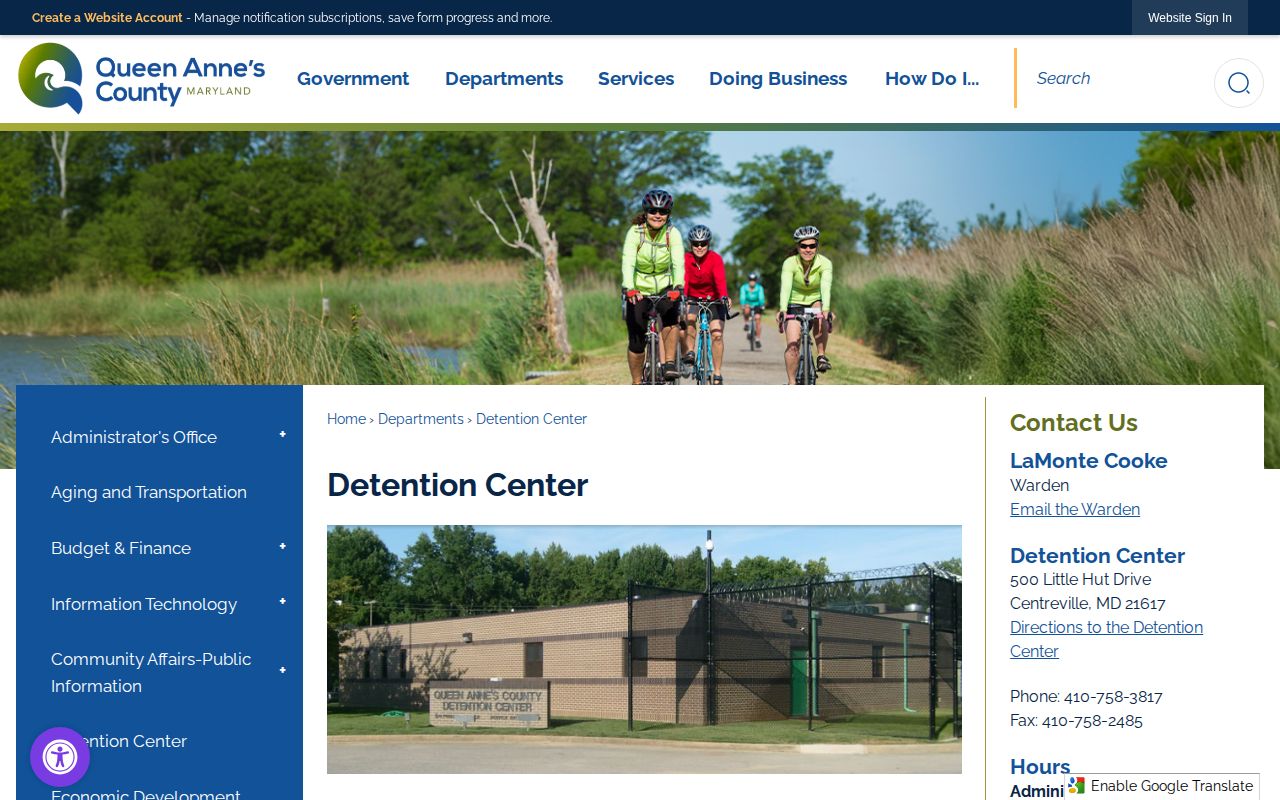
The facility page helps identify the right local custodian before a records request is sent.
Find Queen Anne's County Released Inmates
Start with the last known custody system. Queen Anne's County Detention Center holds local and pretrial commitments and some sentenced people. DPSCS holds state prisoners. BOP holds sentenced federal prisoners, while ICE may hold a person in immigration custody. One person can move through several systems, so each source must be read within its scope.
- Search Maryland VINE by name or identification number for a custody event. Check the reporting agency and identifiers before treating the result as the same person.
- Search Maryland Judiciary Case Search for the Queen Anne's County case. Review disposition, bond, sentence, release-order, and later modification entries.
- Call the detention center for the correct public-information route and ask whether the person went to the community or another custodian.
- Submit a narrow county request when an oral response is unavailable or does not give the actual event fields.
- Follow any transfer through DPSCS, BOP, ICE, or the named local facility. Then use supervision records if parole, mandatory supervision, or probation applies.
Write down the time of each search, spelling used, system scope, and exact result. “No records found” cannot be enlarged into proof of release. When sources conflict, the office that created the relevant custody or court event should resolve it. A time-bounded local request can replace a missing public recent-release feed.
Maryland Search for Queen Anne's Releases
The DPSCS Incarcerated Individual Locator is a current custody-location tool, not a discharge archive. It covers people currently held in specified Division of Correction facilities, Patuxent Institution, and some short-sentenced people in certain pretrial and detention settings. DPSCS expressly states that people no longer in custody, including due to release or escape, are not listed.
| Search field | Type | Limit |
|---|---|---|
| First name | Text | Use an accurate known name or justified variant |
| Last name | Text | Required to distinguish likely matches |
| Returned institution | Result | Supports covered current location only |
| No match | Result state | Does not prove release, discharge, escape, or transfer |
No verified public field supplies an actual, projected, tentative, or maximum release date for a removed person. Historical state release facts require VINE, the sentence and court record, Parole Commission or supervision channels when relevant, and a focused DPSCS PIA request. Ask for the actual release mechanism, date, sentence milestones, and code definitions rather than citing the empty locator result.
Queen Anne's Recent Release Limits
No official public live roster, recent-release list, released-person archive, or released-booking-photo feed was found for Queen Anne's County as of July 23, 2026. There is no verified 24-hour or 72-hour public window, field set, update cycle, or retention period to quote. The Sheriff's app and social accounts cover alerts, updates, safety information, and events, but their published policy does not claim an inmate lookup or jail release list.
Do not rebuild a release feed from arrest news, social posts, or court entries. An arrest notice is not a release record, and a court order may appear before physical departure. Queen Anne's spelling also attracts false matches with other Maryland places. Confirm the facility, county, and court in each result.
For a defined window, ask the Department of Corrections for releasable entries showing actual departures, release or transfer times, event types, and destination indicators. Ask which event categories are included and request the code key. The center runs around the clock for custody, while administrative hours are weekdays from 8:00 a.m. to 4:30 p.m. Custodial operation does not mean round-the-clock public record production.
Queen Anne's Release Court Channels
Queen Anne's County has both District and Circuit criminal channels. Circuit Court handles felonies and other matters within its authority, while District Court handles many misdemeanors, preliminary proceedings, and other criminal matters within its authority. One episode may touch both. Search by the case number and correct court instead of assuming every detention release belongs to Circuit Court.
Maryland Judiciary Case Search can show the court, case number, party, filing date, charge history, disposition, and sentence or docket events when public. It is an index, not the complete file. A certified order, commitment, docket, or clerk copy is stronger evidence. Older Queen Anne's County records, restricted matters, and document-level detail may require local clerk access.
The official Queen Anne's County Criminal Department page is useful because it routes inquiries to the detention center, District Court, commissioner, and local Parole and Probation office. It also links to court search resources.
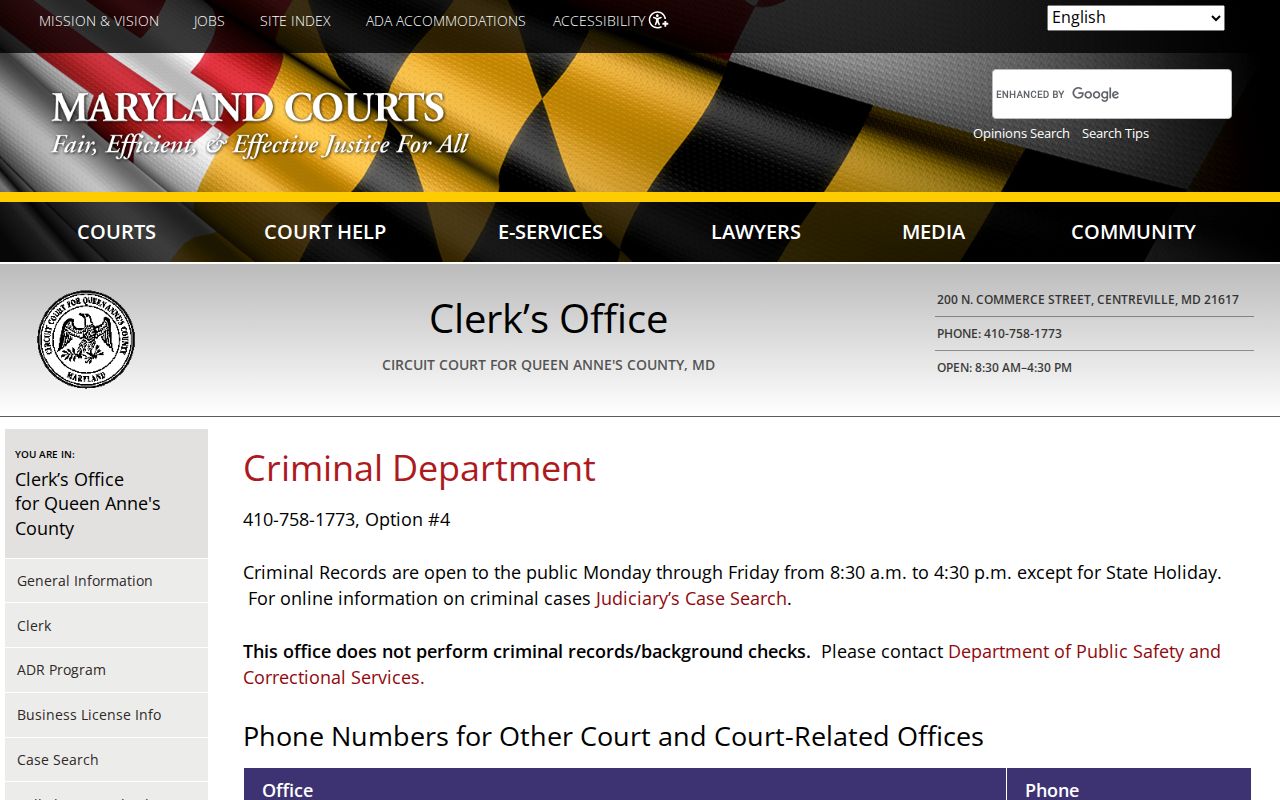
The routing page helps match the needed proof to the local office that controls it.
Queen Anne's Release Supervision
Parole is conditional release to the community while a state sentence continues. Mandatory supervision is also conditional release before maximum expiration after credits advance the date. Probation is imposed by a court and may follow jail, accompany suspended time, or apply without a jail term. None of these terms means the whole case or sentence record has vanished.
- Parole
- Conditional community release granted through the Maryland Parole Commission.
- Mandatory supervision
- Conditional release driven by sentence credits before maximum expiration.
- Probation
- Court-ordered community supervision that may or may not follow confinement.
- Discharge
- The end of the controlling custody or supervision status identified by the agency record.
Check the sentence, release paperwork, VINE notice, or Commission information to identify the type. Then use the Division of Parole and Probation office for the correct public contact process. Individual details may be limited. A parole approval can be delayed while a home plan, program, or other prerequisite is completed, so approval is not proof of same-day physical release. More detail appears under Post-Release Supervision.
Reentry After Queen Anne's Release
Queen Anne's County reentry materials document navigation for eligible discharged detainees, peer support, and continuity-of-care work. A September 2025 County Commissioners update says reentry staff coordinate with the Health Department to meet people with upcoming releases and connect them with resources.
That local work can help a person move from detention into community care. It cannot be used as a public named-person release-date source. For confirmation, return to the detention event, the court action, and Maryland VINE. Reentry planning may happen before a date is final, and release details can still change.
Queen Anne's Release Notifications
Maryland VINE is the main live bridge between custody and a reported release or transfer. Search by name or identification number, confirm the reporting agency, and register by phone, email, text, TTY, or app where offered. A phone registration uses a four-digit PIN. A VINE event is a useful lead, but the detention center or court should confirm the official Queen Anne's County release record.
Federal and immigration cases use different systems. The BOP Inmate Locator can retain released federal prisoners and show a historical release date. “Not in BOP custody” does not rule out local, state, USMS, ICE custody, or supervision. USMS has no comparable public historical release locator.
ICE's locator covers current detention and people released within a limited prior period. Search with the A-number and country of birth, or exact biographical facts. An ICE pickup from Queen Anne's County is a transfer, not a community release. A missing ICE result may reflect the system's window, data match, or scope. No dedicated ICE facility or current ICE contract was verified in Queen Anne's County.
Where Queen Anne's Releases Appear
The same name can be absent from one system and present in another without any source being wrong. The person may have moved between custodians. Choose the source by the kind of release or custody being tested.
| Source | What it can show | What it cannot prove alone |
|---|---|---|
| Detention center record | Actual local release or transfer event | Later status in another system |
| Maryland VINE | Reported custody, release, transfer, or supervision event | A certified local detention record |
| Judiciary Case Search | Public docket, disposition, order, and sentence entries | Exact physical departure time |
| DPSCS locator | Covered current state custody and location | Historical release or projected date |
| BOP locator | Federal custody result or historical federal release date | Freedom from all other custody |
| ICE locator | Covered current or recent immigration detention status | A permanent release history |
Which source is strongest? For physical departure from the Queen Anne's County Detention Center, use the actual detention release or transfer entry. Add the court order for legal authority and follow any named receiving custodian.
Queen Anne's County Release Facility
The one mapped adult detention facility is the Queen Anne's County Detention Center, 500 Little Hut Drive in Centreville. It serves courts and local and state law-enforcement agencies under the county Department of Corrections. A person may leave for the community after bond, a court order, completion of a local sentence, or another lawful release. The center can also transfer someone to DPSCS, another jurisdiction, federal custody, immigration custody, or another legal custodian.
Confirm a local departure with the detention release record, the court case, and Maryland VINE. If the record says transfer, continue with the receiving agency. No state prison, BOP prison, dedicated ICE center, or separate municipal jail was verified within Queen Anne's County, so none should be treated as a second county release facility.