
Queen Anne's Locator Date Limit
The Maryland DPSCS Incarcerated Individual Locator is a current custody-location tool. It accepts first and last name and covers specified people in Division of Correction facilities, Patuxent Institution, and some short-sentenced people held by the Division of Pretrial and Detention Services. DPSCS expressly says people no longer in custody, including because of release, are not listed.
No verified public result field called “Projected Release Date,” “Tentative Release Date,” or “Maximum Expiration Date” was found in that locator. A blank result cannot be converted into a forecast or an actual release. The person may be outside the tool's scope, held in another system, transferred, released, or recorded under different identity data. Queen Anne's County also operates its own detention center, so a local detainee may never be a current locator match.
Queen Anne's Release Date Sources
The correct source follows the custody type. A Queen Anne's County pretrial case has no fixed sentence-based release date. Bond, recognizance, dismissal, and court orders can change status. A local sentenced term is calculated under the commitment and Maryland's local correctional credit rules. A state sentence is calculated by DPSCS under the judgment and state credit statutes.
| Custody situation | Best date source | Main limit |
|---|---|---|
| County pretrial detention | Court docket/order and detention-center confirmation | No set sentence-expiration date may exist. |
| Local jail sentence | Queen Anne's County Detention Center calculation and court commitment | Credits and later orders can alter the date. |
| Maryland state sentence | DPSCS sentence calculation, judgment, and releasable agency records | The public locator does not publish the forecast. |
| Parole consideration | Maryland Parole Commission action | Eligibility or approval is not the same as release. |
| Actual release | Facility or DPSCS release entry, checked with VINE and court records | A notification alone is not certified proof. |
A transfer must be separated from release to the community. Departure from Queen Anne's County Detention Center may lead to DPSCS, another county, federal custody, or immigration custody. The local release or movement record should state the event and destination when releasable.
Note: A court order may authorize release before the person physically leaves, so compare the order with the agency's actual departure entry.
Find Queen Anne's Projected Release
Start with the judgment rather than trying to estimate from a charge or arrest date. A sentence may contain several counts, a suspended part, concurrent or consecutive terms, and credit for time served. Each point changes the calculation. The official agency balance is stronger than arithmetic performed from a public docket summary.
- Identify the court judgment, effective sentence date, and the exact commitment that controls custody.
- Apply pretrial credit only as ordered and resolve which terms run at the same time or one after another.
- Determine whether Queen Anne's County or DPSCS holds the person and ask that custodian for the current sentence calculation.
- Identify the offense date and classification, then consult the credit statutes that govern that sentence.
- Obtain the current credit balance, maximum-expiration calculation, and any mandatory-supervision milestone that may be releasable.
- Check parole action, detainers, other commitments, and court changes separately.
- Recheck after discipline, program completion, resentencing, or another event that changes the calculation.
- Confirm the actual release with the custodian and VINE instead of inferring it from a missing locator result.
For a local term, contact Queen Anne's County Detention Center and identify the person, commitment, and date range. For a state term, use the DPSCS Public Information Act route to request releasable historical or sentence-calculation fields. Maryland Judiciary Case Search can locate the case, but a clerk-produced judgment or commitment is better evidence of what the court ordered.
The broader Queen Anne's County release search connects the custody record, court docket, and transfer checks when the last facility is uncertain.
Maryland State Release Credits
Maryland's state credit system is not a universal 85-percent rule. Under Correctional Services §§3-701 through 3-711, the governing rate depends on the sentence, offense, date, and credit type. Section 3-704 generally grants advance good-conduct deduction at 10 days per calendar month, but generally uses five days when the term includes a concurrent or consecutive crime of violence or a specified high-level drug offense.
Other statutes address credit for satisfactory work, qualifying education or treatment, education completion, and special projects. The combined credit is capped under the applicable rules. Credits can also be revoked or restored through lawful process. They reduce custodial time toward the applicable release point, but they do not erase the court's sentence.
The DPSCS commitment unit calculates the term, credit, and release date. State research reports that work and program credits are recalculated through an electronic monthly process, while the confined person receives a sentence-calculation printout each year and may seek information through a case manager. Those are internal records. The absence of the same data from the public locator is not a gap that a reader should fill with an estimate.
The Maryland state diminution-credit statute page shows the legal starting point for the calculation.
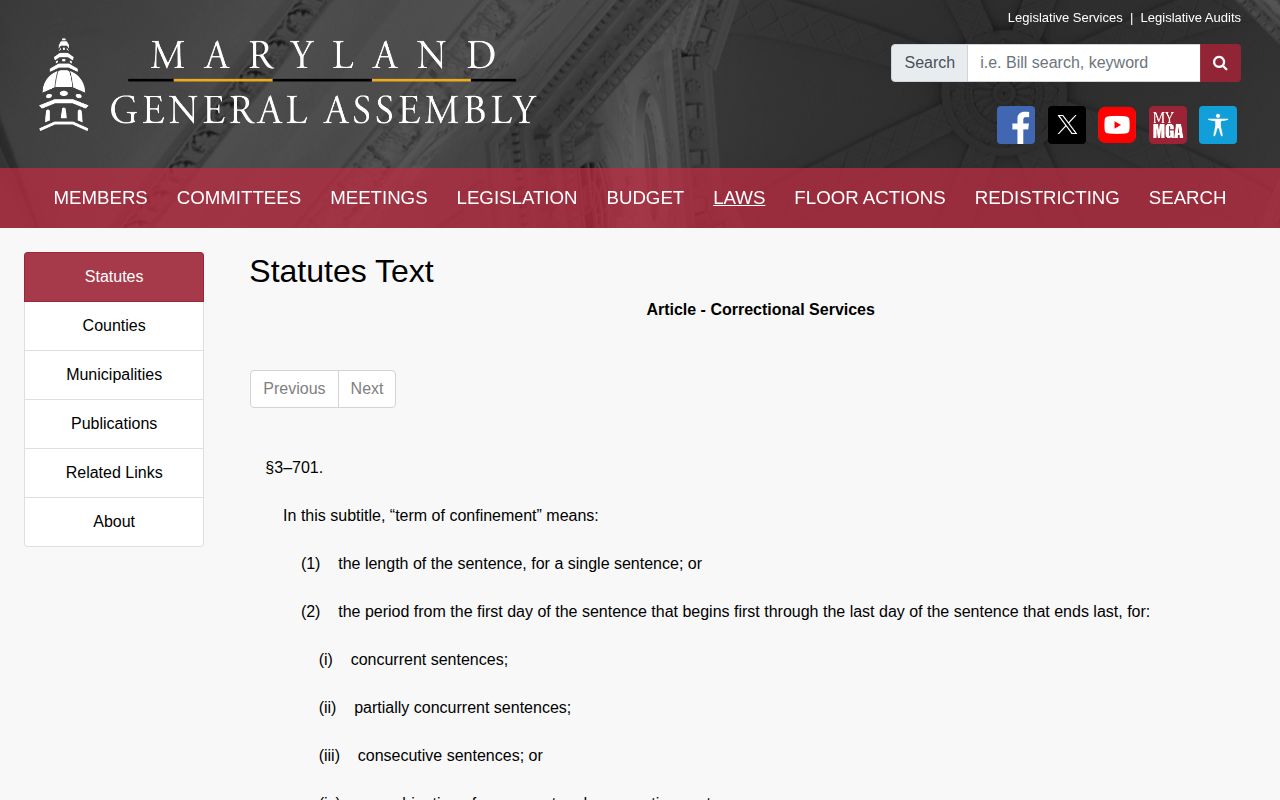
The statute must be read with the judgment and current agency record because the controlling version and sentence details matter.
Queen Anne's Local Release Credits
A person serving a local detention sentence follows Maryland Correctional Services Title 11 and the court commitment, not the state-prison formula by default. The state report summarizes postsentence good-conduct credit under §11-504 as generally five days per month for a violent crime or specified high-level drug term and 10 days for other covered terms. Presentence good-conduct credit, work tasks, education, and special projects have separate provisions.
Local credits may be revoked only through the process required by law. Properly documented local credits can transfer when a person moves into the Division of Correction system, but the receiving calculation controls after that move. Ask the Queen Anne's County Department of Corrections for the current official calculation and code meanings. Do not apply a state DOC assumption to a county sentence.
The Maryland local correctional credit provisions supply the statutory framework for Queen Anne's County sentences.
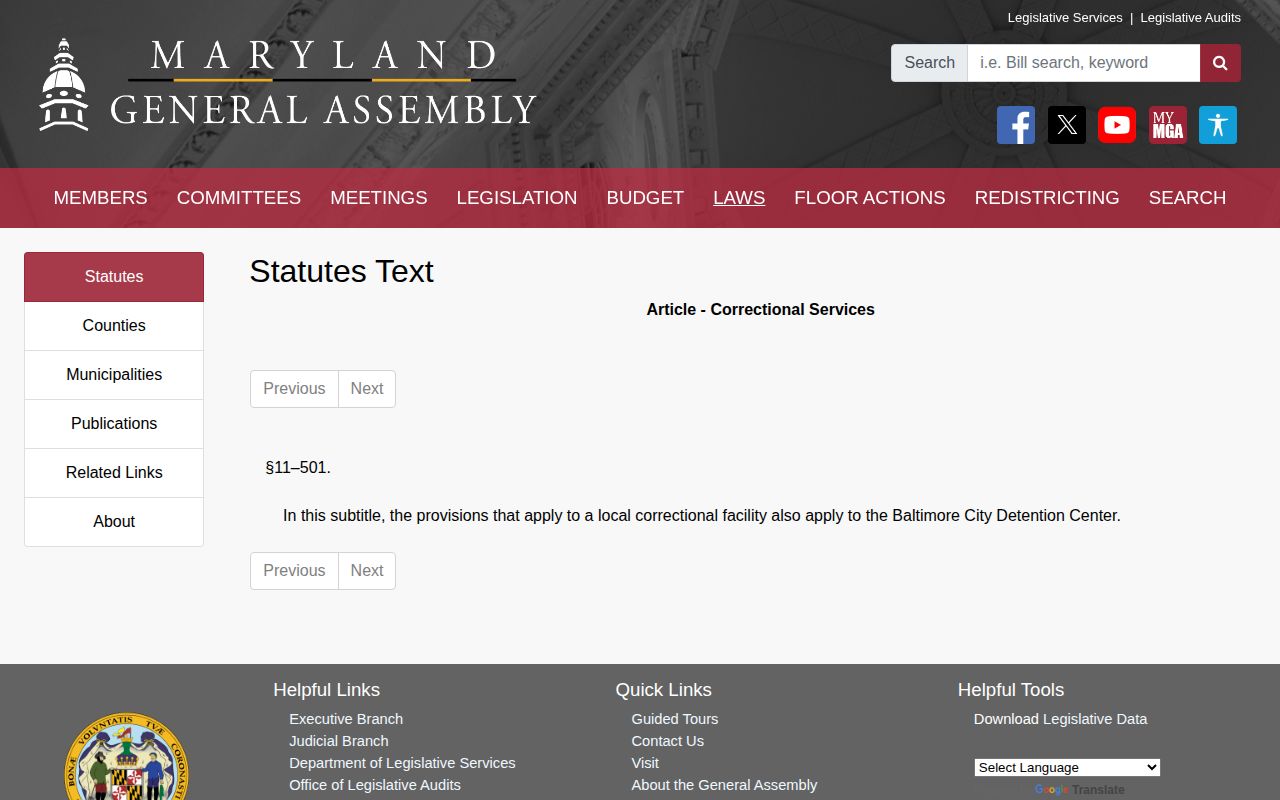
This local framework is why the detention center, court commitment, and current credit balance must be read together.
Note: Credit rates depend on the offense, sentence, and controlling law, so no single percentage predicts every Maryland release date.
Queen Anne's Mandatory Release Dates
For qualifying Maryland terms, accumulated credits can advance a person to conditional or mandatory release before the full sentence expires. Under Correctional Services §§7-501 and 7-502, the person may remain in legal custody on mandatory supervision until maximum expiration and must follow parole-like conditions. Release from confinement is therefore not always discharge from the sentence.
- Maximum expiration
- The last day of the sentence that ends last, based on the controlling terms.
- Diminution credit
- A statutory credit that can reduce time served in confinement toward a release point.
- Mandatory supervision
- Conditional community release caused by credits, with legal custody continuing to full-term expiration.
- Discharge
- The end of the legal sentence or supervision, which is distinct from leaving a cell.
A Queen Anne's County record may therefore contain several dates: court sentence date, projected release milestone, mandatory-supervision date, maximum expiration, and actual departure. Use the agency label exactly. Do not collapse these fields into one “release date.”
Parole and Queen Anne's Dates
Parole eligibility is only a hearing threshold. Under Correctional Services §7-301, the general starting point for an eligible term of at least six months is one-fourth of the aggregate term. Violent-crime, life, nonparolable, and certain repeat drug sentences have different rules. The offense date also matters.
An approval still may not produce same-day release. The Maryland Parole Commission can require a home plan, program completion, or other pre-release conditions. Many approvals are delayed to a future month or year, and later institutional events can suspend the plan. The actual release should be checked through DPSCS or the holding facility.
The Maryland parole eligibility statute shows why eligibility is not a promised release date.
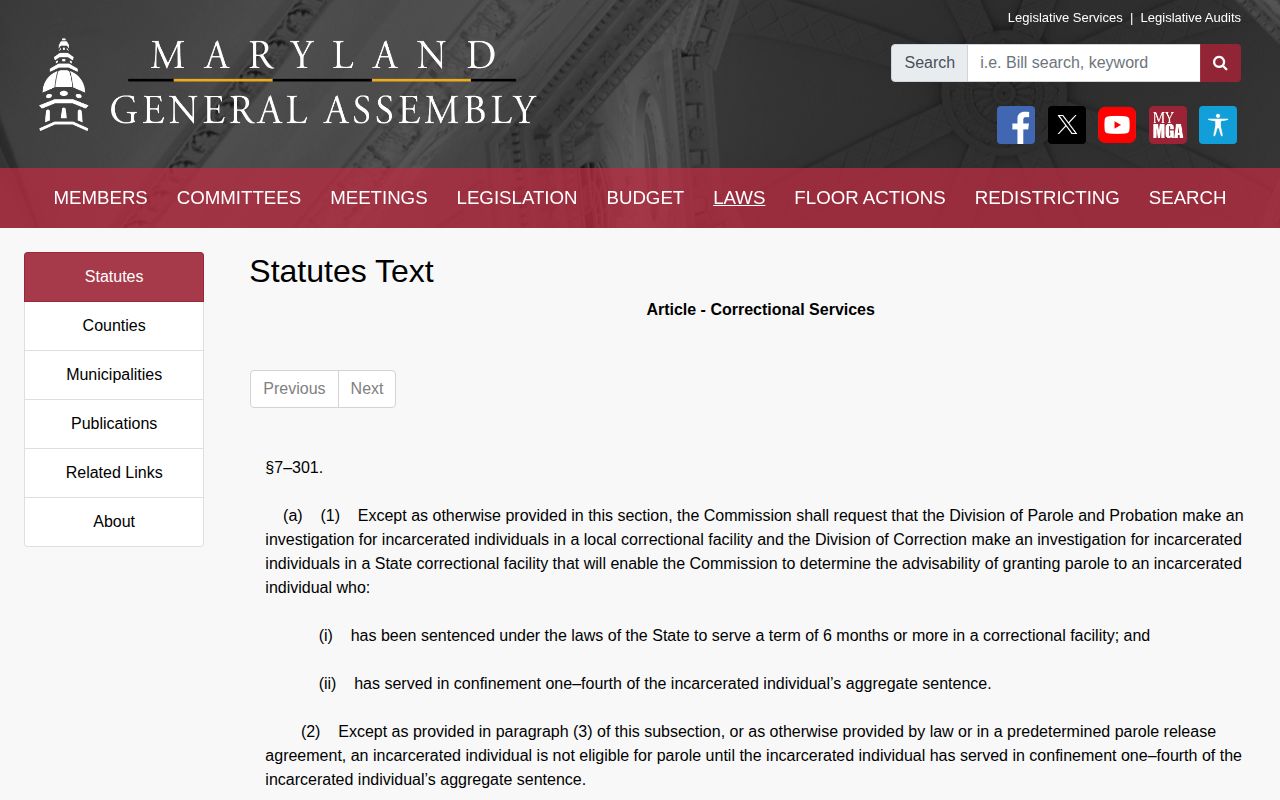
A Commission decision and all unmet conditions must be reviewed before relying on any planned date.
Why Queen Anne's Dates Change
A forecast is a snapshot of current facts. The agency recalculates when one of those facts changes. Some events move a date earlier, others move it later, and some replace the controlling legal basis altogether.
| Change | Possible effect | Record to check |
|---|---|---|
| Credits earned, revoked, or restored | Changes the credit balance and release point. | Current agency sentence calculation. |
| Court resentencing or correction | Changes the term, start, suspended portion, or time-served credit. | Updated judgment and commitment. |
| New concurrent or consecutive term | May alter the aggregate sentence and maximum expiration. | Court judgment and agency calculation. |
| Detainer or warrant | May cause transfer or continued custody after one term ends. | Custodian movement record and issuing agency. |
| Parole action | May create, delay, deny, or suspend a conditional release plan. | Parole Commission action and DPSCS record. |
| Program completion or discipline | May add credit or affect approval and release conditions. | Agency credit and institutional records. |
Escape time, legal changes, and correction of bad data can also affect the result. Reconfirm the date after any major event. A calculation copied weeks earlier may no longer be current.
Confirm Queen Anne's Actual Release
The final step is evidence of departure. For the county jail, ask Queen Anne's County Detention Center for the actual release or transfer date and time, the authority, and the destination indicator where public. For state custody, seek the DPSCS release entry or other releasable agency document. Compare the court order to the physical departure because the two times can differ.
Maryland VINE can add a custody-change alert, but it is not certified proof. The Queen Anne's County VINE inmate check explains the person search, registration, and confirmation limits. Keep the search time, event wording, and agency name. If sources conflict, the custodian that created the release record is the best place to resolve the conflict.
A precise date request should identify the exact commitment and ask the agency to label each date it supplies. Court-order time, projected release, mandatory-supervision release, maximum expiration, data-entry time, and physical departure are not interchangeable. Clear labels keep a valid sentence milestone from being reported as the day the person actually walked out.